
Navigating Your Path: A Guide to the Risk Breast Cancer Recurrence Calculator
- Jul 28, 2025
- 14 min read
When you first hear the term risk breast cancer recurrence calculator, it can feel incredibly cold and clinical. It’s easy to feel like your entire experience is being boiled down to a sterile percentage. But I want to reframe this for you.
These calculators aren't crystal balls, and they certainly don't seal your fate. They're powerful tools, designed to bring clarity to a sea of complex medical information. Think of them not as a judgment, but as a guide—a way to turn abstract risks into concrete numbers you and your oncologist can discuss, empowering you to make the choice that is right for you.
A Tool for Clarity, Not Fear

Let's try to reframe how we look at these calculators. Instead of seeing them as a verdict, see them as a detailed map. This map takes all your personal health information—things like your original diagnosis for hormone-positive or hormone-negative cancer, tumour characteristics, and treatment history—and translates it into a statistical estimate. It can show you different potential paths forward, highlighting the statistical benefits of adding certain treatments.
I was in this exact spot when I was weighing the decision to go back on Endocrine Therapy. The side effects had been overwhelming, and I was just completely drained. My oncologist sat with me and used one of these tools to walk me through my options. Seeing the numbers laid out so clearly was what I needed at that moment to make an informed choice.
Numbers Are Information, Not a Life Sentence
The calculator showed me the specific percentage of risk reduction that continuing the therapy might give me. It showed me the numbers. And I needed to see that. For me, seeing that data allowed me to weigh a concrete benefit against the daily reality of the side effects I was experiencing. It helped me see that for me, the side effects outweighed the need to go on it. I chose to try again, but the process itself was empowering.
Ultimately, you are not a statistic. The numbers are a tool, and that’s all.
My oncologist used this tool to walk me through my options, and his best advice was this: “Do what is right for you. No decision is wrong.” This is the message I want to pass on to you. These tools support your conversation; they don't dictate your life.
This entire journey is about using every resource you can find to make choices that bring you peace, whether you're navigating side effects from treatment or considering future therapies.
Living Beyond the Numbers
Let's be real for a minute. Living with the fear of recurrence is hard. I’m preaching to the choir here—I am afraid every single day of getting to the point of no return. It’s hard not to be. But try.
I've learned that fixating on the numbers doesn’t actually help. It just feeds the fear. Instead, I try to focus on the things I can actually control. Don't let the numbers weigh on you. Live your life.
Nourish your body: Fuelling yourself with good nutrition can make a real difference in managing treatment side effects and just feeling stronger overall.
Reduce your stress: Find what brings you a sense of calm and joy. Do what you can to reduce stress and live healthy.
Live your life fully: The numbers aren't everything. What's meant to be will be, and living in fear of recurrence doesn't help. It robs you of the beautiful moments happening right now.
A recurrence calculator is just one tool in your survivorship toolkit. Use it to find clarity, talk about it with your doctor, and then trust yourself to choose the path that feels right for you.
So, how do these recurrence calculators actually work their magic? It's not a crystal ball, but it's the next best thing: sophisticated math built on decades of real-world clinical data from thousands of women just like us.
These tools take the unique details of your cancer story and feed them into a powerful algorithm. Think of it like building a deeply personal profile where every single detail matters. My goal here is to pull back the curtain and show you why certain factors are so critical, so you can understand the numbers without the fear.
The Key Ingredients of Your Profile
To get a truly personalized estimate, your oncologist will input very specific data points. These aren't random; each one tells a crucial part of your story and helps the calculator build an accurate picture of your individual situation.
The most critical inputs usually include:
Your Original Diagnosis: This is the foundational stuff, like the stage of the cancer (how large it was and if it had spread) and its grade (a measure of how aggressive the cells looked under a microscope).
Tumour Characteristics: This gets into the nitty-gritty of your specific cancer. Was it hormone-receptor positive (ER/PR-positive), meaning estrogen or progesterone was its fuel? Or was it hormone-negative? Your HER2 status is another vital piece of this puzzle.
Lymph Node Involvement: Whether or not cancer cells were found in your nearby lymph nodes is a really significant factor in figuring out risk.
Treatments You've Had: The calculator also considers the therapies you’ve already been through, like surgery, chemotherapy, and radiation.
Here’s an example of what the input screen for one of these risk assessment tools might look like.
This screenshot gives you a sense of just how detailed these tools are. It’s this level of specific information that lets the calculator move beyond generic statistics and give you an estimate that’s much more relevant to you.
Why Every Little Detail Matters
The reason this all works is that different types of cancer behave in very different ways. Someone with hormone-positive breast cancer, for instance, has a completely different risk profile than someone with hormone-negative cancer.
Hormone-positive cancers might have a lower risk of coming back in the short term, but they can recur many, many years down the road. This is why treatments like endocrine therapy are often part of the long-term plan. Understanding the nuances of recent breakthroughs in breast cancer treatment options can also add another layer of context to these conversations with your doctor.
Your personal data provides the 'why' behind the numbers. It connects the dots between your diagnosis, your treatments, and your potential future, turning a cold percentage into a meaningful piece of information for your health journey.
This is especially important when you think about the sheer size of the survivor community. In California alone, there are over 550,000 women living with a history of invasive breast cancer, making these tools essential for sorting out individual risk.
Nationally, the risk of recurrence can be anywhere from 5% to over 30%. A calculator helps pinpoint where you might fall on that wide spectrum, which is absolutely critical for guiding decisions about your long-term care. You can find more details in this report about breast cancer facts and figures.
Getting the Most Out of the Calculator
This is where you move from being a patient to being your own best advocate. Using a risk of breast cancer recurrence calculator isn’t something that just happens to you; it's a tool you can actively use to get clarity and feel more in control. It’s all about getting ready for a meaningful, productive conversation with your medical team.
Your oncologist is the one who will actually plug your details into a trusted tool like Predict or Adjuvant! Online. These aren't calculators you should try to use on your own at home—the inputs are highly specific and making sense of the results really requires a professional's eye.
Your job is to walk into that appointment informed and ready to participate in the process.
How to Prepare for Your Appointment
Before you even get to your doctor's office, take some time to get familiar with your own medical details. You can find everything you need in your pathology reports. Just understanding your own data is a huge and empowering first step.
Make sure you know:
Your Tumour Details: What was the size and grade of your tumour? What was its hormone receptor status (ER/PR-positive or negative)?
Lymph Node Status: Were your lymph nodes involved? And if they were, how many showed signs of cancer?
Your Treatment History: Keep a clear list of all the surgeries, chemotherapy, or radiation treatments you've already been through.
This visual gives a simple breakdown of the kind of personal information these powerful tools need to work.
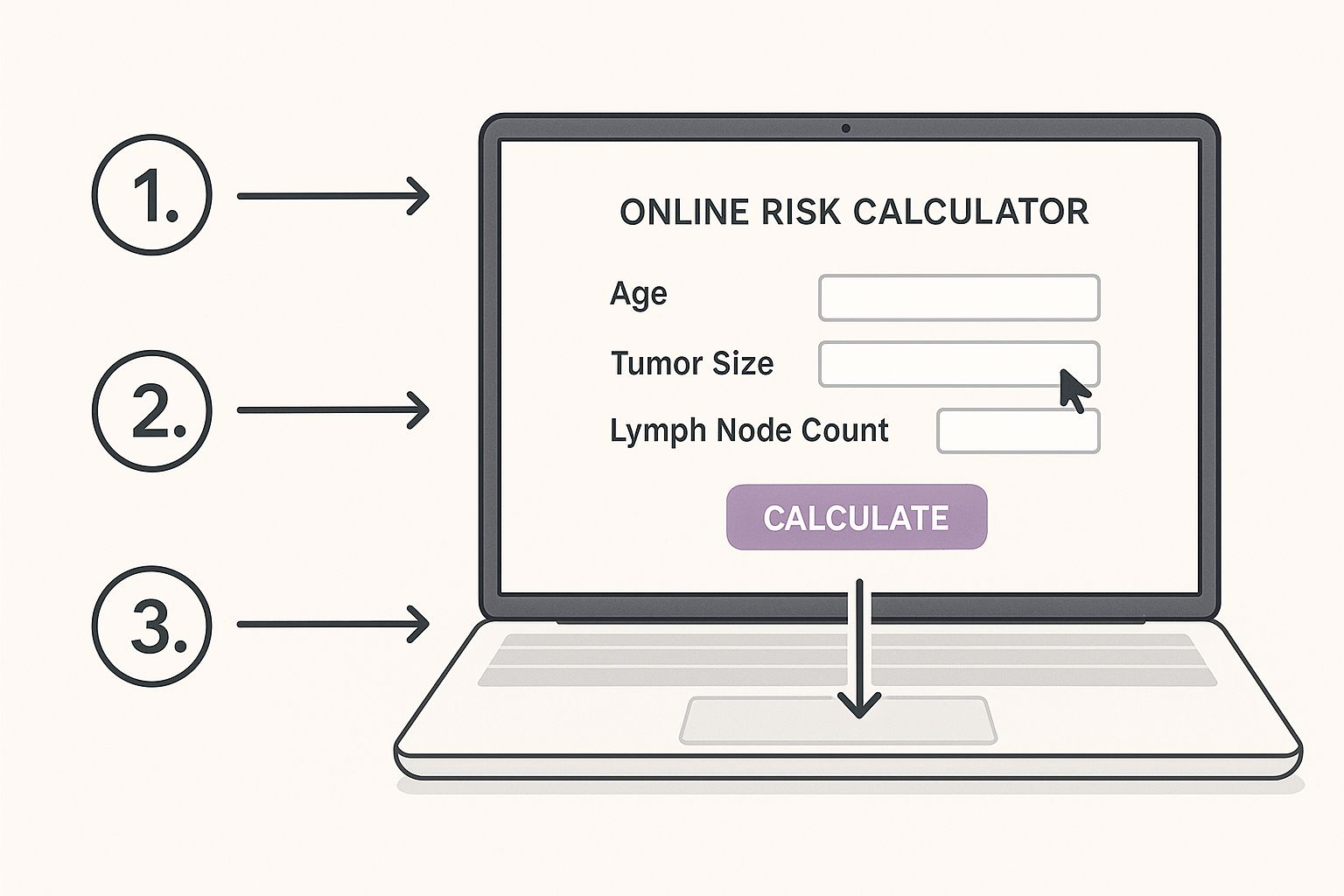
When you see all the fields laid out like this, it really hits home how personalized the calculation is. It's all built around your specific health data.
Guiding the Conversation
When your oncologist starts walking you through the numbers, that’s your cue to jump in with questions. Try to frame them in a way that helps you truly understand what your choices are and what they mean for you.
Instead of just asking, "So, what's my risk?" try asking things like:
"How would this percentage change if we were to add this particular therapy?"
"What are the most common side effects women experience with that option?"
"Based on my personal history and what you know about me, how do you weigh the benefits against the impact on my quality of life?"
I can still picture myself sitting in that appointment, my head just swimming with all the numbers. I used this. The calculator laid out the statistical benefit of going back on Endocrine Therapy. It showed me the numbers. For me, I needed to see that the side effects for me outweighed the need to go on it. I chose to try again, but having that data gave me the power to make my own choice.
My oncologist gave me the best advice I could have asked for: “No decision is wrong.” He reminded me that this tool was here to support our conversation, not to give me a final verdict.
Remember, this is a team effort. If the numbers feel like too much, just say so. Your medical team is there to help you explore every single option and find the one that feels right for you. You are in the driver's seat of your own health.
When the Numbers Don't Tell the Whole Story
A risk breast cancer recurrence calculator will give you a percentage. A cold, hard number.
But you, my friend, are not a percentage. This part of the journey is where we talk about the most important factor of all: your quality of life beyond the statistics. The numbers aren't everything.
These tools are brilliant at what they do, but they can't measure the things that truly define your daily existence. They can't calculate your mental wellbeing, your energy levels, or the very real, lived experience of treatment side effects.
This is a struggle I know intimately. When I was weighing up the decision to go back on Endocrine Therapy, the numbers showed a statistical benefit. But my reality was different. The side effects were draining the life out of me, leaving me exhausted and feeling like a shell of myself.
Weighing Data Against Your Wellbeing
This is where you have to become the chief executive of your own health. You have to weigh the data from the calculator against your own personal wellness. What is the real-world cost of that statistical benefit? How does it affect your ability to find joy, to work, to simply be?
For some women, enduring difficult side effects for a reduced risk is a worthwhile trade-off. For others, the impact on their quality of life is too high a price to pay. And that's okay.
My oncologist used this tool to walk me through my options, and his best advice was this: “Do what is right for you. No decision is wrong.” It's about what is right for you, in this moment.
Living in constant fear of recurrence is a heavy, suffocating burden. It’s a fear I battle every single day—that worry of reaching a point of no return. It’s hard not to feel that way. But we have to try. We have to try to find peace and live fully, regardless of what any number says. For more on this, you can explore our guide on understanding and managing the psychological effects of breast cancer.
Practical Steps for Living Fully
So, what can you control? You can focus on nourishing your body and soul. This isn’t about erasing risk; it’s about improving your life, right now. Don't let the numbers weigh on you. Live your life.
Manage Side Effects Through Nutrition: Simple dietary shifts can sometimes make a world of difference for issues like fatigue or joint pain that come with hormone therapy.
Reduce Your Stress: Stress is a powerful force. Finding your personal outlet—whether it's yoga, painting, gardening, or deep breathing—is not an indulgence; it's a necessity. Do what you can to reduce stress and live healthy.
Find Your Joy: Actively seek out moments of happiness. Don’t let the numbers on a screen overshadow the beauty in your life.
This is particularly relevant in places like California, where it's projected that there will be approximately 44,600 new invasive breast cancer diagnoses in 2025. While the mortality rate is thankfully lower than in many other regions, the sheer number of survivors means countless women are navigating this exact same balance between statistics and quality of life. Learn more about these vital breast cancer statistics from Komen.org.
Ultimately, a calculator is a guide, not a gospel. See the numbers. Understand them. But what’s meant to be will be. And living in fear of recurrence doesn't help.
Your Life, Your Choice, Your Path Forward

So, you’ve gathered all the information. You’ve sat with your oncologist, stared at the numbers from the risk of breast cancer recurrence calculator, and now you’re wondering… what’s next?
This is where the real work—and the true empowerment—kicks in. It's time to take that data, all the medical advice, and your own powerful intuition and forge a path that is uniquely, completely yours.
This moment is about so much more than a single decision. It’s about grabbing the reins of your own story. Whether you choose to pursue a recommended treatment, stop one that’s draining your spirit, or focus entirely on lifestyle, your choice is valid. No one else has lived in your body or walked a single step in your shoes.
Building Your Path Beyond the Numbers
That calculator gives you a statistical snapshot, but you are the one painting the full, vibrant picture of your life. This is your journey to navigate with strength, self-compassion, and an unwavering trust in yourself. The numbers are just a guidepost, not the destination.
My own oncologist used this very tool to walk me through my options. He showed me the numbers. But the most important thing he told me was that no decision is the wrong one. It's about doing what is right for you.
For me, seeing those numbers helped me weigh the brutal side effects of Endocrine Therapy against the potential benefits. It gave me the clarity I needed to try again, but it was my call to make.
You are the leading expert on your own body and your own life. Use the tools, listen to the experts, but always, always trust yourself to make the final call. The numbers aren't everything.
Living in constant fear of recurrence doesn't help. I know how hard it is to quiet that voice; I am preaching to the choir here, as I am afraid every day of getting to the point of no return. But we have to try. Do what you can to lower stress, live healthily, and find pockets of joy. For more support on this, you might find comfort in our guide to hope and healing in your breast cancer recovery.
Your Survivorship Action Plan
While you’re making medical choices, taking charge of your overall wellbeing is one of the most powerful things you can do. It's an act of self-care and a way to create a life that feels good, no matter what any statistic says.
Here’s a way to think about building a plan that supports you—body, mind, and spirit.
Your Survivorship Action Plan Beyond the Numbers
Focus Area | Actionable Steps and Ideas | Why It Matters |
|---|---|---|
Nourishing Your Body | Focus on whole foods, colourful veggies, and plant-based proteins. Try anti-inflammatory recipes to help with side effects like joint pain. | Good nutrition fuels your body, supports your immune system, and directly impacts your energy levels and how you feel day-to-day. |
Calming Your Mind | Explore mindfulness, gentle yoga, journaling, or just spending time in nature. Find what truly helps you unplug and quiet the mental noise. | Lowering chronic stress is vital. It helps you sleep better, think more clearly, and feel more in control of your own health. |
Moving with Joy | Find movement you genuinely enjoy—dancing in your kitchen, walking with a friend, or swimming. Ditch the "shoulds." | Regular physical activity is proven to boost mood, fight fatigue, and support a healthy body weight—all crucial parts of survivorship. |
At the end of the day, what’s meant to be will be. Don't let the numbers weigh you down.
Take a deep breath. Trust your gut. And take the next step forward. Your life, your choice, your beautiful path.
It's completely normal to have a million questions swirling around after treatment. Survivorship brings a whole new world of things to figure out. Let's tackle some of the most common questions I hear (and had myself!) about using a risk breast cancer recurrence calculator. Hopefully, this brings a little more clarity to your journey.
Which Recurrence Calculator Is the Most Accurate?
This is a big one. You'll often hear about a few highly respected tools that oncologists trust, with 'Predict' and 'Adjuvant! Online' being two of the most common ones.
Honestly, there isn't one "best" tool for everyone. The right one really depends on the nitty-gritty details of your specific cancer—like whether it was hormone-positive or negative and all the data packed into your pathology reports.
The most important thing isn't picking the tool yourself. It's about sitting down with your oncologist and going through the results together. They're the only ones who can truly interpret the numbers within the full context of your unique medical history, your treatment, and your life.
Can I Use These Calculators By Myself at Home?
I know how tempting it is. Some of these tools are online, and the urge to just plug in the numbers and see for yourself can be strong. But this is something I’d strongly advise against doing alone.
These calculators require very specific, complex data from your pathology reports. It's easy to misinterpret a field or enter something incorrectly, and even a tiny error can dramatically skew the results.
But more importantly, seeing a number without context can send you into a spiral of unnecessary anxiety. It’s so much better to use these tools with your doctor. They can make sure the information is entered correctly and, most critically, help you understand what the results really mean for you.
What if the Results From the Calculator Make Me Anxious?
First, just take a deep breath. It is completely and totally normal to feel a wave of anxiety when you see these numbers. I’ve been there. That feeling can be absolutely overwhelming.
Remember, this calculator is just one piece of a very large, complicated puzzle. It's a tool based on data, but it doesn't know you. It doesn’t account for your spirit, your resilience, or how your individual body responds to treatment. It certainly can't measure your quality of life.
Use the results as a starting point for a conversation, not as a final verdict on your future. My oncologist used this tool with me but was quick to remind me that no decision is wrong. The right choice is the one that feels right for you.
Try to shift your focus to what you can control: nourishing your body, protecting your mental health, and making informed choices that bring you a sense of peace. I know it's easier said than done, but don't let the numbers weigh on you.
Can Lifestyle Changes Affect My Recurrence Risk Number?
This is such an excellent and important question. The short answer is that, right now, the clinical calculators don't have fields to input things like your diet, exercise routine, or stress management. Their algorithms are built purely on the clinical and pathological data from your diagnosis and treatment.
But—and this is a big but—that absolutely does not mean lifestyle is irrelevant. Far from it. In fact, it's one of the most powerful things in your survivorship toolkit.
A healthy lifestyle has been proven time and again to support your overall wellbeing, help manage the often-difficult side effects of treatments like hormone therapy, and may lower your overall risk. Your oncologist will always recommend healthy habits as a vital part of your care plan, working hand-in-hand with any medical treatments you're on.
In places like California, these tools are even being enhanced with local data to give more personalized estimates. With 1 in 8 women in the U.S. developing breast cancer, understanding all these nuances is key to navigating your own path to wellness. You can explore more about these important breast cancer facts on NationalBreastCancer.org.
At Grace Grit and Pink Ribbons, we believe in empowering you with information and supporting you with compassion. We're here to remind you that you are so, so much more than a statistic. Explore our resources and join our community as you continue to walk your path with strength and grace.


Comments